Looking For God… In all the Wrong Places

2009 December 6
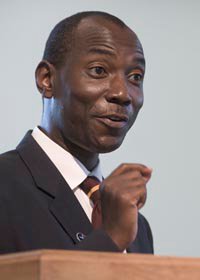
by Rev. Patrick ONeill

In his excellent new book, Science and the Search for God, Gary Kowalski passes along a story that the late James Luther Adams used to tell to his classes at Harvard Divinity School and at the University of Chicago Divinity School, where I was once privileged to have him as a teacher.

It’s the story of the minister of a small congregation in an old New England mill town who once every year treated the worshippers at his church to a long-winded sermon on astronomy, detailing everything that had been discovered about the stars and planets during the preceding twelve months. His parishioners –cotton brokers, bankers, weavers and other down-to-earth sorts – sat through this annual ordeal with patient resignation. Finally someone asked him, “What is the use of knowing so much about the far reaches of empty space?” To which the minister replied, “No use at all maybe, but it greatly enlarges my idea of God.”

Of course, this way of thinking about God – as an external Power somewhere “out there,” larger and more mysterious even than the Universe, is fairly traditional in the Western world. The God image that comes down to us through Judeo-Christian tradition is indeed a “sky” divinity, who rules “the heavens,” the Creator/Overseer who set the cosmos in motion, who “looks down” upon our world, and within whose benevolent celestial consciousness all Creation finds its place, its order, its purpose, and reason for being.

This is the God most of us grew up with, and the God the rest of us rebelled against, and this is the image of God that most people in America understand the word, “God,” to mean.

Oh, of course there are lots of people, even in traditional churches, but more outside them, whose thinking about the notion of God has actually gone beyond such narrow definition. And many such folks eventually find their way into churches like ours, looking for alternative spiritual understandings, broader more inclusive understandings of the human spirit.

And in most other parts of the world, of course, in non-Judeo-Christian cultures past and present, the notion of God, of the Divine, of Sacred Source, takes wildly different shapes, different conceptions, different experiences altogether.

But it is interesting to note that in every major poll taken every few years in America, somewhere between 97% and 99% of the population insist that they believe in this particular Western kind of God. That is to say, a personal God who is a Being, all-powerful, all-knowing, all-loving, and at the same time, all-judging: a kind and loving Father-God who is apparently more than capable of severely punishing his own children who fail to obey his commands. A merciful God, we were assured, who is paradoxically capable of visiting floods and catastrophes of every description upon his Creation, selecting his favored and faithful for eternal reward with his right hand, while casting his wayward children, Scripture tells us, into eternal damnation with his left hand.

We hear about the growth and noise of fundamentalist and extreme conservative churches that are booming in this country, and where that old-time religion-kind of God is still passionately preached. You can watch five channels full of that preaching tonight if you get cable tv. And sometimes I do. But in fact, currently only about 40% of Americans attend any kind of worship on a weekly basis. That is down some 20% in the last 40 years.

Mainline churches in America are almost all increasingly vacant on Sundays: Methodists, Episcopalians, Congregationalists, Presbyterians, and Lutherans have all experienced downturns in membership, in contributions, and in their own clergy recruitment over the last two decades in particular.

But should it really surprise anyone, given the state of the world today, given our advances in scientific and cultural knowledge, that we are conflicted about this traditional God whom so many of us were raised to believe in?

Is it really surprising that so many people have abandoned the pews of traditional churches to go looking for another kind of God, wherever such a God may be found? Is it so surprising that so many people today feel they have become strangers in the spiritual homes of their parents; to a point where they feel like exiles in the houses of worship where they grew up; feel like spiritual orphans in the traditions of their own families?

Does it surprise anyone that so many young families today have actually become pilgrims of a sort, taken to the spiritual road, and have actually gone “church-shopping,” in search of…. what? something that was missing in the churches and temples of their upbringing by the time they themselves became adults, by the time they themselves became parents; looking for some kind of “sacred center” –call it God, call it “Ground of Being,” call it what you will – to make sense of their lives in a very complex and confusing time; looking for something to teach their own children, to give their own children a foundation for distinguishing right and wrong, giving their own children a sense of ethical obligation for building a better world, more fair, more just, more caring for those in need.

They become pilgrims, so many young families today, searching to fill what Sartre called “the God-sized hole in the human heart.”

Maybe you’re among them, a whole generation of young families today, of young single people, young working professionals, well educated, many living great distances from their family roots, many looking for a spiritual community to be at home in, to call their own.

Perhaps you are among the large number of people today who are looking for a reasonable religion, with an image of God that does not insult their intelligence or make a mockery of their learning; a God image – or a pathway, or a discipline, or a spiritual community – that invites reverence rather than fear; that offers ways of thinking about God which evoke unity rather than division between people and across cultures; a sense of what shall we call it, sacredness? – holiness? Wholeness? Soulfulness? Wholeheartedness? – that we feel at the center of our humanity and which we sense other people feel too: something we could share with each other if we were braver and more honest with other, if we weren’t somewhat embarrassed to admit it to one another – a profound notion that sees in every other human being a brother or a sister who is just as lost and confused as we are in this world; just as deserving of the same rights and dignity and respect as we are; just as frightened for and protective of their children as we are; carrying inside them the same passions for peace, the same dreams for their children’s children, the same humanity, the same hopeful and tragic stories, the same hurts and wounds.

We are all of us, every person you will meet today, every person you are privileged to touch in this life, we are all of us the same, alive and dying at the same time, every minute. And it is the knowledge of this miraculous and terrible truth that makes all of us homeless in this world, all of us searchers for the meaning of our lives, all of us pilgrims, needing to praise and give thanks for our blessings, needing to weep and mourn our mortality.

Religion is nothing more or less than the manner in which we acknowledge the gift of our lives, the rituals wherein we sing the privilege of our place in Creation. We imagine God as the Creator Image. We call upon Allah. We bow before Yahweh. We revere Gaia. We travel to mountaintops. We wander in deserts. We immerse ourselves in holy rivers and sacred streams. We pray and we fast and we remove our shoes on sacred ground. We meditate and retreat from the busyness of our lives, from our calendars of commitment. We paint and dance and sing and give words to the inexpressible.

God, we say, resides here in this Book. Or is it this Book? We travel to holy places, build shrines and temples, light flames and sound bells and burn incense before all the altars of the centuries.

And here is the great secret of human spirituality and the religions we have created for ourselves: the God we think we see and understand is finally not found “out there.” We look for God in all the wrong places, because we have never grasped the metaphorical puzzle of God. “Out there” is only a metaphor for what is ultimately “In Here,” in the human heart and “In Here” in the human mind.

God is the metaphor that includes the ultimate mystery, beauty, and value in life. God the Father, Mother, Spirit. God as Being Itself, the Ground of Being, Pure Immanence, Ultimate Concern. God as Omega Point, the God of Process. The God of vengeance, the God of Mercy, the God of Love. The God who died in the Twentieth Century. And the God who is eternal, the God of the human heart.

In Here.”

It occurs to me that virtually all my life I have been one searching after the God “In Here.” At this point in my life, to be honest, I’m more interested in how a theology lives than in how it reads. I think I may even have encountered something of the divine on a few fleeting occasions, and in a very few special persons I have been privileged to know. And I think Sophia Fahs has it right when she intimates that the Holy only becomes manifest when we educate ourselves to view the ordinary world in a religious way.

Those of you who are familiar with my sermons over the years know that I do have a favorite quote that I’m particularly fond of. It appears in many of my sermons because I love it so. It is this wonderful passage from The Color Purple, where one of Alice Walker’s characters is berating another for thinking that God can only be found in church. Her character says:

“Tell the truth, have you ever found God in church? I never did. I just found a bunch of folks hoping for him to show up. Any God I ever felt in church I brought in with me. And I think all the other folks did too. They come to church to share God, not find God….God is inside you and inside everybody else. You come into the world with God. But only them that search for it inside find it. And sometimes it just manifests itself, even if you are not looking, or don’t know what you’re looking for.”

. Or what you call it when you find it.

Share and Enjoy:
  • Print
  • Digg
  • Sphinn
  • del.icio.us
  • Facebook
  • Mixx
  • Google Bookmarks
  • Blogplay

Comments are closed.